
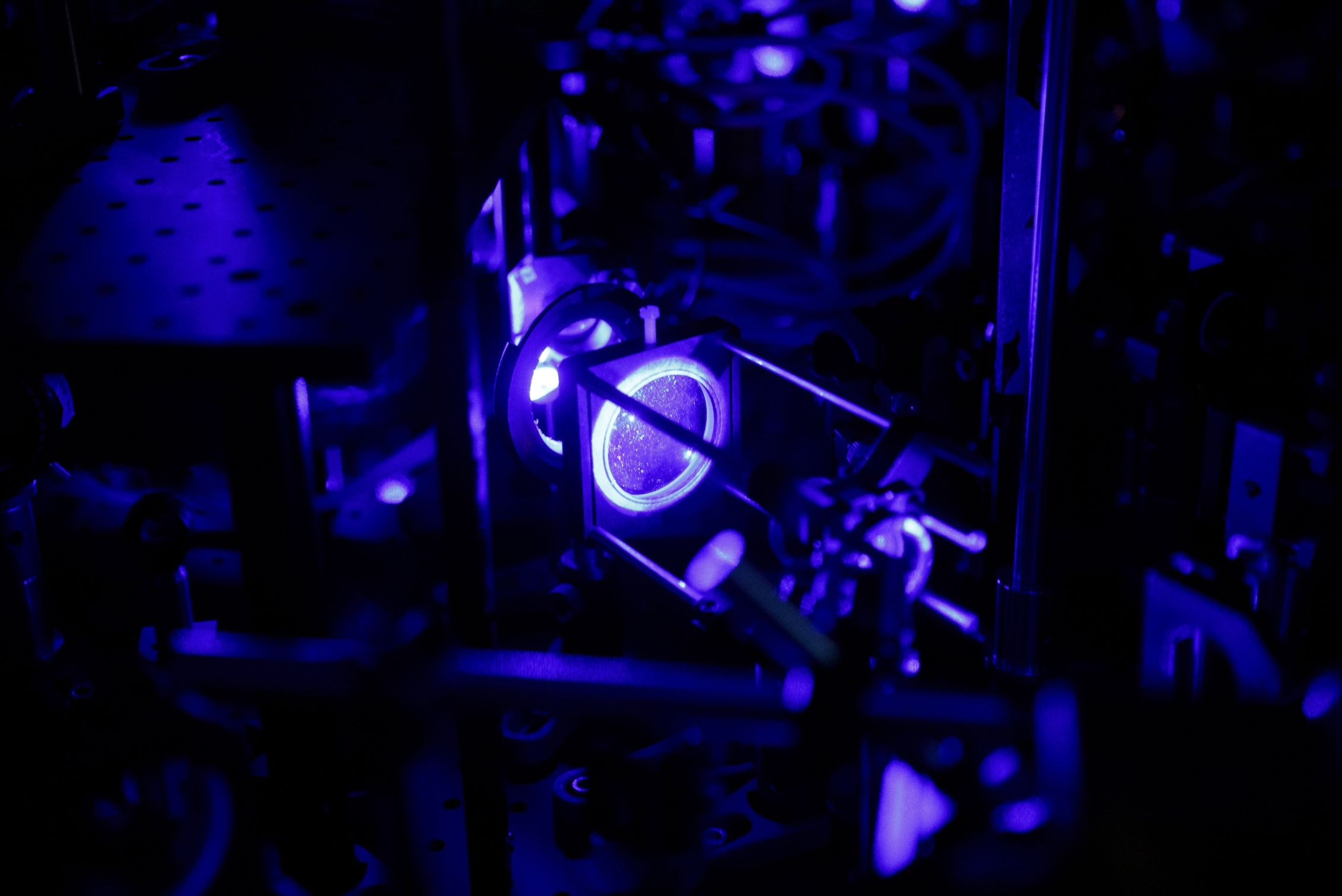
Research activities are focused on Group II Ultracold Gas (G2UG). Group II atoms -like Alkaline-earth or Rare-earth atoms- have two electrons in their valence shell. As a consequence the atom ground-state has no electronic angular momentum (J=0) where as the nuclear spin is also zero (I=0) for the bosonic isotopes and is a half-integer (up to I=9/2) for the fermions.
In the ultracold regime original and complementary behaviors are expected in contrast to the more commonly used Alkali atoms.
Scalar Bosonic BECs leading to Spinless 3D quantum transport in ordered or disordered systems.
Fermionic ultracold gases are fascinating objects. Since the nuclear internal state is well protected to external perturbations such as ultracold collisions, the quantum gas could be described by a Hamiltonian having a SU(N) symmetry. N stands for the ground state degeneracy. Possible applications are fund in:
- Quantum computing
- Quantum phase transition and colored superfluidity
- Gauge field theory
Group II atoms have also very interesting spectroscopic properties related to the presence of the triplet excited spectrum. Weakly allowed transitions are now routinely used for optical clock. Possible applications are:
- Frequency and time standard in optical domain
- General relativity and Galilean invariance tests
- Molecular ultrahigh spectroscopy
The first G2UG project has started in January 2011 on an ultracold gas of Strontium87. One of the major aim is to generate and study non-abelian Gauge field on the ultracold gas.
The gauge theory is said non-abelian when the local transformation group is non-commutative. In the everyday life the rubix cube is one example of a non-commutative transformation. In the fundamental physic world, standard model is a well known example of non-abelian gauge field theory.
The experiment is located at the School of Physical and Mathematical Science (SPMS) at Nanyang Technological University (NTU). It is a Franco-Singaporean project part of the FermiCold operation, mainly funded and under the scientific authority of the Centre for Quantum technologies (CQT). From the French side the partners are l’Institut de Physique du Centre National pour la Recherche Scientifique (INP,CNRS) and l’université de Nice Sophia-Antipolis (UNS).
